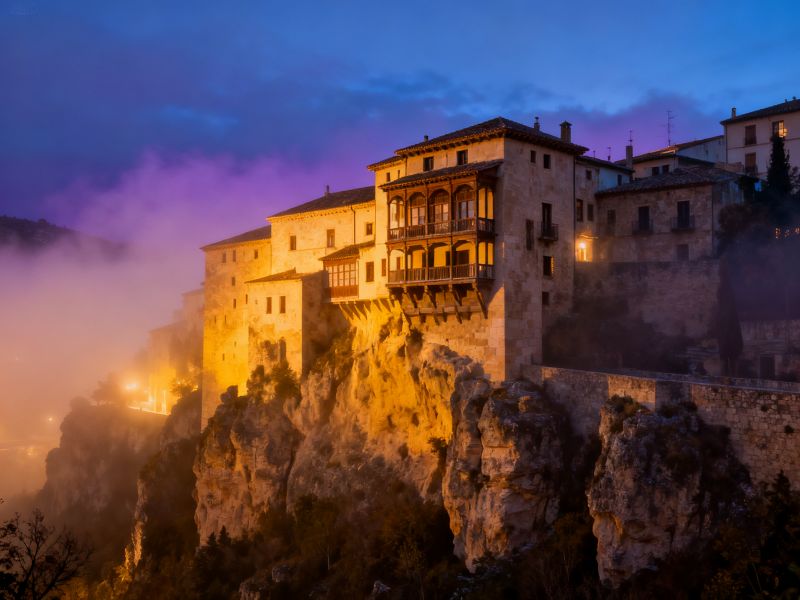
Cuenca sits on a rocky spur between two rivers, its famous 'hanging houses' (casas colgadas) jutting over the Huécar gorge like a dare to gravity. I first saw them on a cold January morning, when mist clung to the medieval walls and the only sound was water dripping from the tiled roofs. This is not a city that greets you with postcard brightness;it reveals itself slowly, in layers of stone, iron。and silence.The old town is a UNESCO World Heritage site, but that label doesn't capture the odd intimacy of its streets. Walk up Calle Alfonso VIII and you'll pass a 12th-century cathedral with a surprisingly modern abstract stained-glass window by Gustavo Torner。installed in 1994. That mix—Romanesque arches and geometric color—is pure Cuenca: tradition refusing to stay frozen. The cathedral's 'transparente' altarpiece, a baroque explosion of marble and light, feels almost theatrical after the austere nave. I stood there for ten minutes, watching how the afternoon sun turned the gold leaf into a moving curtain.Cuenca's craft heritage is equally alive. The city is known for its 'rejas' (wrought-iron grilles) and handmade ceramics, but the real surprise is the Museum of Abstract Art in the hanging houses themselves. Yes。those precarious balconies now hold canvases by Tàpies and Saura. Local guides will tell you that in the 1960s, artists like Fernando Zóbel helped rescue the crumbling structures by turning them into exhibition spaces. That decision saved the skyline and gave Cuenca an identity beyond its medieval past. You can still buy a hand-painted bowl in the Plaza Mayor for under 20 euros, but the better story is that the same families have been shaping clay here since the 16th century.
Food in Cuenca is honest and unpretentious. I ate 'morteruelo'—a thick game pâté with bread and pine nuts—in a bar with no menu, just a chalkboard and a waiter who shrugged when I asked for wine recommendations. He poured a local Tempranillo from a clay jug. That's Cuenca: no fuss, no performance. The city's position at the edge of the Serranía de Cuenca means wild mushrooms and trout appear on tables within hours of being gathered or caught. Try 'ajoharina' in winter, a garlicky flour stew that warms you from the inside out.What stays with me most is the sound of Cuenca at dusk. The bells of San Pedro church ring across the gorge, and the hanging houses cast long shadows over the river. It's a place that rewards slow walking and repeated visits. Tourism has grown—there are now more guided tours in English than a decade ago—but the city hasn't lost its stubborn, slightly melancholic character. Cuenca doesn't try to charm you. It simply exists。
stone by stone, and lets you decide whether to keep climbing.