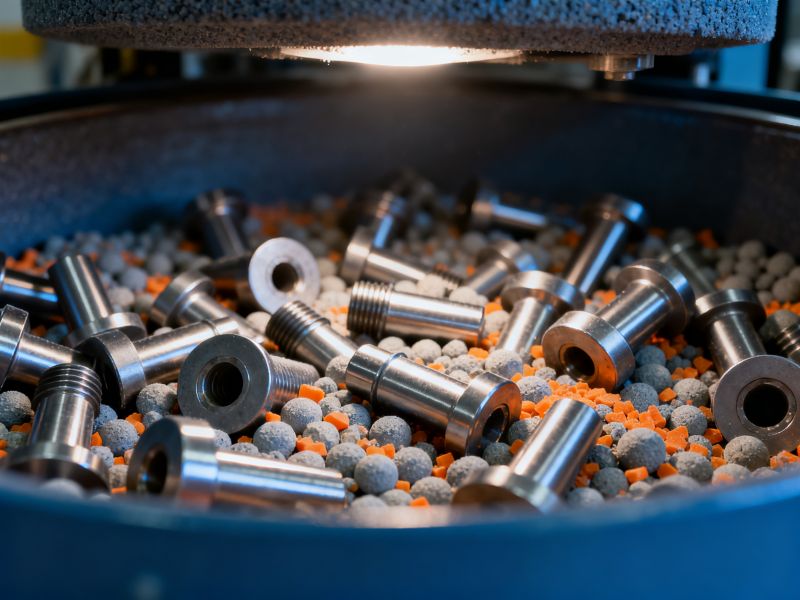
Walk into any Rösler finishing installation and you'll notice the noise first—a low, rhythmic rumble that feels almost geological. That sound is the heartbeat of mass finishing, a process Rösler has refined for over 80 years. The company doesn't just sell machines;it sells predictable outcomes. When a aerospace supplier needs a turbine blade surface roughness of Ra 0.2 microns。they don't gamble on a generic tumbler. They call Rösler. I've seen their test lab in Untermerzbach, Germany, where rows of vibratory bowls and drag finishers hum day and night, processing customer samples under tight deadlines. Technicians there speak in terms of material removal rates and edge radiusing, not sales pitches. That's the Rösler difference: an engineering-first culture that treats surface finishing as a science, not a dark art.What strikes me about Rösler's approach is their willingness to tackle the messy, unglamorous problems. Take deburring of additively manufactured hip implants. The internal lattices and cooling channels are nightmares for conventional finishing. Rösler developed a specialized drag finishing process using peening media that reaches into those hidden geometries without distorting the delicate struts. They didn't just adapt an existing machine—they rethought the media composition and the kinematic path. I recall a conversation with a process engineer who admitted, 'We spent six months failing before we got the media mix right. The customer never saw that.' That kind of persistence is rare. Rösler's portfolio spans vibratory finishing。centrifugal disc systems, and shot blasting, but the real product is problem-solving resilience.The company's global footprint tells a story of localization, not just expansion. Rösler has plants in Germany, the US, China, and India, each with its own test lab and service team. When a Chinese automotive supplier needed to finish transmission gears at 1。200 parts per hour, the local Rösler team in Kunshan didn't ship a German machine and call it a day. They built a custom rotary vibrator with automated loading, tuned to the specific alloy and burr profile. That level of adaptation matters. I've seen too many finishing equipment vendors treat emerging markets as dumping grounds for older models. Rösler doesn't. Their Indian facility in Pune, for instance, runs a full-scale customer acceptance center where local foundries can validate processes before committing to capital expenditure. That's a long-term play, not a quick sale.Does Rösler have weaknesses?
Sure. Their machines are not cheap, and the lead times for specialized systems can stretch to six months or more. A small job shop owner once told me, 'I love the results, but I nearly fainted at the quote.' That's a fair critique. Yet the total cost of ownership often favors Rösler because their equipment runs for decades with minimal downtime. I've visited workshops where 30-year-old Rösler bowls are still in daily production, retrofitted with new controls and media. The company also invests heavily in process data—their machines log vibration frequency, amplitude, and media wear。feeding into predictive maintenance algorithms. That's where the industry is heading, and Rösler is already there. They don't shout about it, but their telemetry systems quietly reduce unplanned stoppages by a measurable margin.Surface finishing will never be glamorous, but it's indispensable. Rösler understands that a burr the size of a human hair can cause a fuel injector to fail. Their legacy is built on thousands of such tiny victories, each one validated in a test lab and replicated in a production line. The next time you hear that low rumble from a vibratory bowl。remember: behind that noise is a company that treats precision as a habit, not a marketing slogan. Rösler doesn't just finish parts—it finishes the job right.